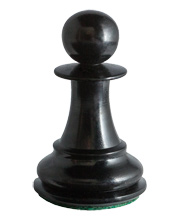
Lacquered
A lacquer coating generally gives the pieces a smoother, more uniform surface, with more sheen and stronger reflections in bright light. The lacquer may be clear or coloured.


Match the size letters: any Size M chess pieces can be paired with any Size M chess board, and any Size L chess pieces with any Size L chess board. If the letter matches, the sizes are compatible.
Our Chess Sets include both chess pieces and a chess board. We have already paired the sizes for you.
Start with either Chess Pieces or a Chess Board. Stay within the same M or L size, or open Combine with… on the product page to see our recommended matches.
Every product page for chess pieces or a chess board includes a section called Combine with…. Open it to see recommended matches for the product you are viewing: chess boards for chess pieces, or chess pieces for a chess board.
On a desktop, Combine with… is one of the tabs below the product information. On a phone or tablet, scroll below Add to basket and tap the Combine with… row to open it.
The recommendations are a curated starting point, not the only compatible choices. As a general rule, pair Size M pieces with a Size M board, and Size L pieces with a Size L board.
If you are considering mixing the M and L size groups, you are welcome to contact us for help checking the proportions.
| Match | Chess pieces | Chess board |
|---|---|---|
| M + M | Size M King height 3.75–4.2 in (9.5–10.7 cm) | Size M 5.0 cm (1.97 in) squares |
| L + L | Size L King height 4.25–4.75 in (10.8–12.1 cm) | Size L 6.0 cm (2.36 in) squares |
The circles show the king’s base viewed from above. The king usually has the widest base in a chess set, so it is used for this comparison. A smaller base leaves more visible space around the piece, while a larger base creates a fuller look.
About 75% More open
About 80% Balanced
About 85% Fuller
Choose chiefly according to the sheen, reflections and surface feel you prefer. This section focuses on those surface qualities; woods, natural colours and decorative colour treatments are covered under Woods and colours. Finish does not affect size compatibility.
A lacquer coating generally gives the pieces a smoother, more uniform surface, with more sheen and stronger reflections in bright light. The lacquer may be clear or coloured.
Without a lacquer coating, the pieces generally have a lower sheen, and more of the wood’s natural surface character remains apparent to the touch. Unlacquered does not mean unfinished.
Neither represents a higher or lower level of quality. The difference is one of appearance and feel.
Our chess boards are described as high-gloss, matt or ultra-matt according to their level of sheen and reflection.
The difference can also be felt: high-gloss boards generally have a smoother, more uniform surface, while matt and especially ultra-matt boards have a fine surface texture that is more apparent to the touch.
No. Lacquered chess pieces can be paired with a matt chess board, and unlacquered pieces with a high-gloss board. Matching and contrasting finishes are both valid choices.
For fewer reflections, start with unlacquered pieces or a matt or ultra-matt board. For a more reflective appearance, look for lacquered pieces or a high-gloss board.
This section explains the woods, natural colours, grain patterns and decorative colour treatments used in our chess pieces and boards. See Finish for surface sheen, reflections and feel.
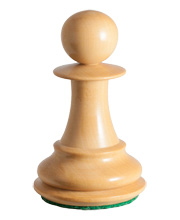
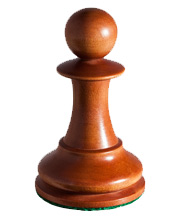
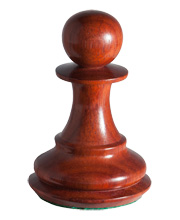
Chess board descriptions identify the woods and veneers used for the playing surface. Examples in our range include root of elm with maple, root of walnut with maple, and ash burl with poplar.
Natural colours and grain patterns vary from board to board, so each board is slightly different.